
Chromoly isn’t a fitment shortcut. Heavy-duty axle shafts for 4WD setups need to match the axle and differential, while material choice should reflect the vehicle’s gearing and terrain. Aftermarket shafts can use 4140 or 4340 chromoly, steel strengthened with chromium and molybdenum.
It’s easy to focus on material strength, but spline compatibility and how the vehicle is used matter just as much. This guide explains what chromoly offers, how vehicle setup and terrain affect shaft choice, and which fitment details to weigh before selecting an upgrade. You’ll get a practical starting point for choosing shafts that suit your four-wheel-drive system, rather than relying on material name alone.
Key Takeaways
- Match shaft selection to the vehicle’s axle, differential and spline configuration, not material strength alone.
- Account for terrain and driving style, since shock-loading can shear an axle shaft.
- Compare chromoly grades and heat-treatment methods to understand how shaft construction affects strength.
- Use vehicle setup and intended use to narrow the right heavy-duty upgrade for your 4WD.
Choosing shafts for vehicle setup and terrain
Match the shaft to your vehicle’s make, model, year and differential. Then consider the axle configuration, terrain and driving conditions against the shaft’s design.
Make, Model and Year Fitment
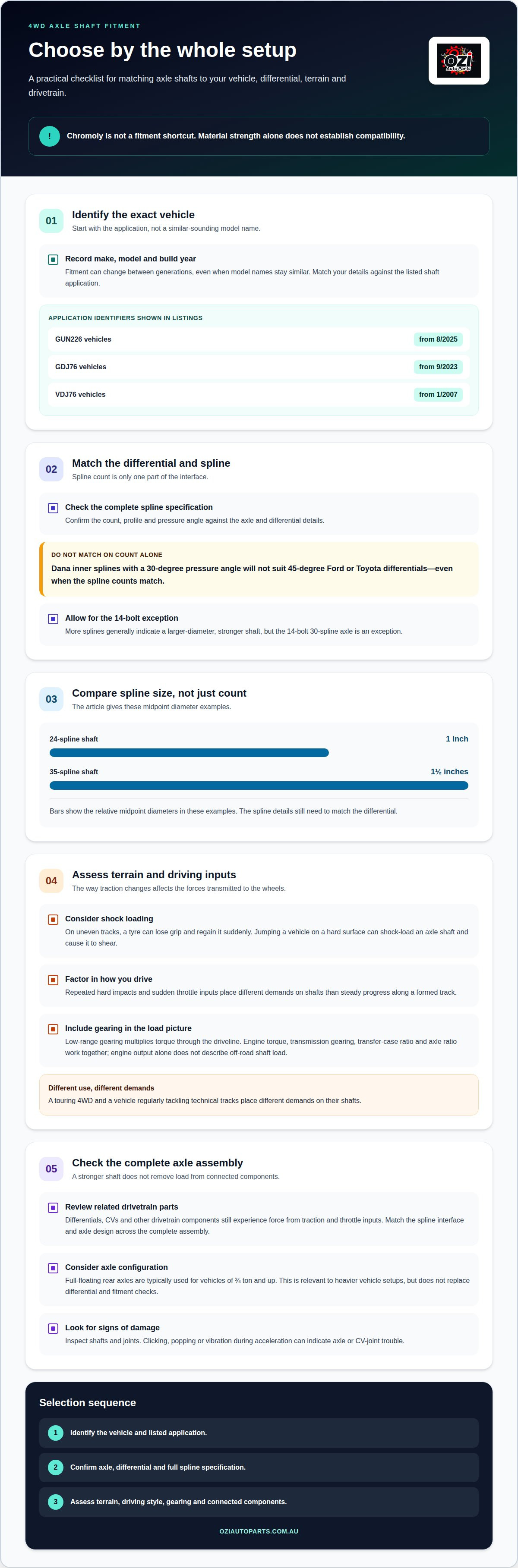
Start with the vehicle’s exact make, model and build year. Fitment can change between generations, even when model names remain similar. For example, axle-shaft listings include GUN226 vehicles from 8/2025, GDJ76 vehicles from 9/2023 and VDJ76 vehicles from 1/2007. These identifiers help distinguish applications. Record the vehicle details before comparing shaft options, then match them against the listed application. A close model-name match alone doesn’t establish fitment.
Differential Compatibility
Next, match the shaft’s spline design to the differential. Spline count is only one part of compatibility; profile and pressure angle also matter. Spline specifications can vary, so check the axle and differential details before choosing a shaft. Dana inner splines with a 30-degree pressure angle won’t suit 45-degree Ford or Toyota differentials, even when their spline counts match. The 14-bolt 30-spline axle is an exception to the general pattern that more splines mean a larger-diameter, stronger shaft. Confirm the complete spline specification, not just the count.
Axle configuration also shapes the decision. Full-floating rear axles are typically used for vehicles of 3/4 ton and up. This design is relevant when assessing heavier vehicle setups, but it doesn’t replace differential and fitment matching. Terrain adds another factor: rocky tracks and uneven ground can increase strain when wheels gain traction abruptly. Consider how the vehicle is geared and driven, not terrain alone.
Use a clear sequence: identify the vehicle, establish its differential and spline details, then assess the intended terrain. A touring 4WD and a vehicle regularly tackling technical tracks place different demands on their shafts. For either setup, matching the shaft to the complete axle assembly is the practical starting point.
Off-road and four-wheel-drive applications
Off-road driving changes the loads an axle shaft must handle. Terrain, traction and driving inputs all affect the forces transmitted to the wheels.
Off-Road Use
On uneven tracks, a tyre can lose grip and regain it suddenly. This abrupt force is called shock loading. Jumping a vehicle on a hard surface can shock-load an axle shaft and cause it to shear. Driving style matters as much as terrain: repeated hard impacts place different demands on shafts than steady progress along a formed track. Consider how you drive, including sudden throttle inputs and wheel impacts, when assessing the strength required.
Four-Wheel-Drive Use
In a four-wheel-drive system, axle shafts transmit drive to the wheels as traction changes. Low-range gearing multiplies torque through the driveline, increasing the load on axle components. The demands on a shaft depend on engine torque, transmission gearing, transfer-case ratio and axle ratio working together. Engine output alone does not describe the load an axle shaft experiences off-road.
A stock 2012 JK Rubicon with a five-speed automatic provides a worked example. The calculation combines engine torque with the vehicle’s gearing and allows for parasitic loss. The calculation is an illustrative estimate for that setup, not a universal rating. Treat this as a specific vehicle example, not a universal rating for other 4WDs.
Use your vehicle’s gearing and typical terrain to frame the upgrade decision. Explore 4WD upgrade parts as a next step when matching components to your setup.
Custom and heavy-duty axle shafts
Choosing a custom shaft means balancing material, spline geometry and the loads on connected components. Fitment and intended use determine which upgrade is practical.
In Australia, roadworthiness and insurance obligations depend on the modification, state or territory rules and policy terms. Check these separately before changing driveline components.
There is no single cost for every setup. Vehicle application, shaft material, spline design and the components required all affect what you need.
Spline Counts and Shaft Sizes
Compare spline count, diameter and profile, not count alone. A 24-spline shaft has a midpoint diameter of 1 inch; a 35-spline shaft measures 1½ inches at the midpoints. More splines generally indicate a larger, stronger shaft, but the 14-bolt 30-spline axle is an exception. Spline details must match the differential.
Drivetrain Compatibility
Axle splines generally twist before the shaft shears. A stronger shaft doesn’t remove load from the differential, CVs or other drivetrain components; those parts still experience force from traction and throttle inputs. Match the complete assembly, including spline interface and axle design, and consider related 4WD upgrade parts as part of the overall setup. Material strength alone doesn’t establish compatibility or protect connected parts.
Installation steps and tools vary with the axle layout and retaining hardware. If a broken shaft is lodged in the differential centre, removal may require specialised tools.
Inspect shafts and joints for damage. Clicking, popping or vibration during acceleration can indicate axle or CV-joint trouble.
Ozi Auto Parts
Ozi Auto Parts supplies 4WD upgrade parts for Australian vehicle setups. Use the fitment and drivetrain details above to identify the components your vehicle requires, then consider the relevant upgrade category.
For a four-wheel-drive build, Ozi Auto Parts offers 4WD Upgrade Parts and Driveshafts, alongside Brake System Parts and Steering and Suspension Parts. These categories support broader component selection when reviewing how axle upgrades relate to the rest of the vehicle’s driveline and chassis.
Contact Ozi Auto Parts to discuss your parts requirements.
Plan your next 4WD upgrade
Make the next parts decision part of a complete vehicle plan. Choosing heavy-duty axle shafts for 4WD use should support the way you intend to drive, while keeping other planned upgrades in view. A considered sequence helps you prioritise components without treating each change in isolation.
Ozi Auto Parts offers 4WD Upgrade Parts, Driveshafts and Brake System Parts for customers selecting components for their vehicle. Keep your requirements focused on the vehicle and intended use when planning the next step.
Contact Ozi Auto Parts about axle shafts to discuss your parts requirements. A clear plan puts your next 4WD upgrade on a practical path.
Frequently Asked Questions
What are heavy-duty axle shafts for 4WD vehicles?
Heavy-duty axle shafts transmit torque from the differential to the wheels, with upgraded construction intended for demanding use. They are part of the axle assembly, so choosing one involves more than selecting a stronger shaft. It must match the differential’s spline interface and the vehicle’s axle configuration to connect correctly and transfer drive.
Which axle shaft materials and designs are strongest for 4WD use?
300M steel is the strongest material identified in the comparisons here, at about 150% stronger than an OE 1040 shaft. That figure doesn’t make material the only selection factor. Shaft diameter, spline geometry and heat treatment also affect the assembly. A design suited to the vehicle’s differential and intended loads matters more than a material label alone.
How do chromoly axle shafts compare with standard OEM shafts?
Chromoly shafts can provide greater strength than standard OEM 1040 steel shafts. A 4340 shaft is about twice as strong as an OE 1040 shaft in the supplied comparisons. Chromoly for driveline use can be hardened through heat treating or induction hardening. Compare the grade and treatment, rather than assuming every chromoly shaft has identical properties.
How do I choose axle shafts for towing, touring, rock crawling or larger tyres?
Start with the vehicle’s axle and differential, then consider how added load affects the driveline. Towing and touring involve sustained vehicle loads; rock crawling brings slow, high-traction obstacles and abrupt wheel loading. Larger tyres also change the demands on the setup. Choose a shaft for the complete vehicle configuration and intended use, not for one modification in isolation.
Which heavy-duty axle shafts fit my 4WD make, model, year and differential?
Match the shaft to your exact make, model and year, then confirm the axle and differential details, including spline count, profile and pressure angle. A similar model name or matching spline count alone does not confirm fitment.