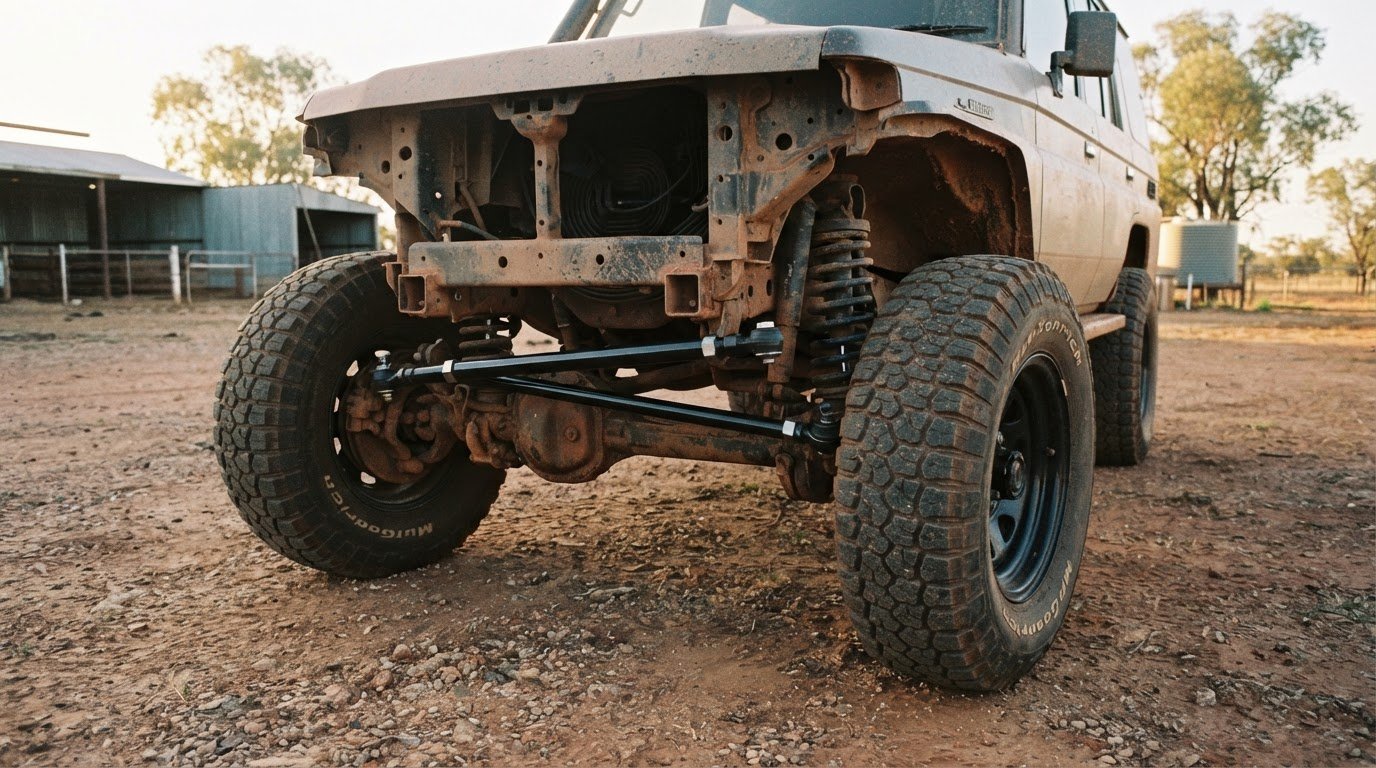
The right heavy-duty tie rod kit for a 4WD depends on vehicle model and year, tie rod end direction, and the steering link configuration. A stronger-looking rod alone doesn’t establish correct fitment.
Fitment matters because tie rod ends transfer steering input to the wheels. Don’t assume left-hand and right-hand ends are interchangeable. Identify the required thread direction and vehicle application before comparing kits.
This guide explains how to compare kits by model and year, distinguish left- and right-hand ends, and assess billet rod options against the specifications provided. You’ll get a practical framework for narrowing the choices and selecting a kit that matches your 4WD’s steering setup.
Key Takeaways
- Match the kit to the exact vehicle model and year, then distinguish inner and outer ends and their thread direction.
- Compare rod material and construction options against the vehicle’s steering setup and intended use.
- Understand how heavy-duty links differ from standard components, including the trade-offs in inspection and maintenance.
- Explore Ozi Auto Parts’ 4WD upgrade and steering parts alongside its other mechanical component categories.
Left-hand and right-hand tie rod ends
Tie rod ends connect the steering rack or linkage to the wheels, transmitting steering input and allowing controlled movement through the front end. Left-hand and right-hand describe thread direction, not the vehicle’s side. The threads must match so the adjusting sleeve can change the linkage length.
A left-hand thread tightens in the opposite direction to a right-hand thread. The wrong thread can prevent adjustment or damage the threads. Toyota LandCruiser and Nissan Patrol applications require the specified end and thread for their steering configuration. The vehicle name alone isn’t enough to identify the correct part.
Inner ends sit towards the steering rack; outer ends connect near the steering knuckle. A Jeep Wrangler parts listing may specify an inner end, outer end or drag-link end. These are distinct positions, even when components look similar. Match the component position and thread direction to the vehicle’s steering layout.
A heavy-duty kit can affect roadworthiness if it changes steering geometry or is fitted incorrectly. Insurance coverage for modifications depends on the policy terms. Disclose steering changes to your insurer.
- Remove the existing linkage.
- Fit the matched ends and secure each connection to the vehicle specifications.
- Set the wheel alignment, including toe.
- Check steering movement through its full range.
A qualified technician can carry out the installation and alignment. Professional service workshops like Eagle Transmission & Auto Repair provide comprehensive automotive maintenance and steering care to ensure heavy-duty front-end components are fitted and aligned accurately.
Tie rod ends facilitate smooth and controlled movement in a 4x4 steering system, so checking their condition on both sides of the front end can help identify wear before it affects steering. If one tie rod end is worn, inspect the other side for wear and replace it if worn. This is particularly relevant for 4WDs used on corrugations or tracks, for towing, or with larger tyres. Inspecting both sides helps identify components that need replacement.
Tie rod kits for different vehicle models and years
Fitment depends on the vehicle’s model, year and steering configuration. A heavy-duty tie rod kit for a 4WD must match its listed application.
Model and Year Compatibility
Start with the make, model and exact year range stated for the kit. For example, tie rod ends and connecting rods identified for a 97-03 Ford F150 apply to that stated range. Don’t assume they suit earlier or later versions. Model updates can change steering components. Fitment details alone don’t establish warranty coverage or consumer rights; those are separate considerations.
Vehicle-Specific Fitment
Fitment depends on the steering layout, not just the vehicle badge. Toyota LandCruiser and Nissan Patrol applications require the specified rod dimensions and end connections. A kit listed for one model won’t necessarily suit another from the same manufacturer. Compare the listed application with the vehicle’s steering arrangement and suspension configuration.
Choosing a Kit for a Modified 4WD
For a modified 4WD, account for suspension changes and altered steering geometry. A lift can change linkage angles and alignment. Follow these steps to select a heavy-duty tie rod kit for your 4WD:
- Check the kit’s listed application and rod dimensions against your vehicle.
- Check that the connection points and end types match your steering setup.
- Check for clearance through steering and suspension travel.
These checks help distinguish a compatible upgrade from one that only shares the vehicle’s make. Include modifications when assessing fitment, not as an afterthought.
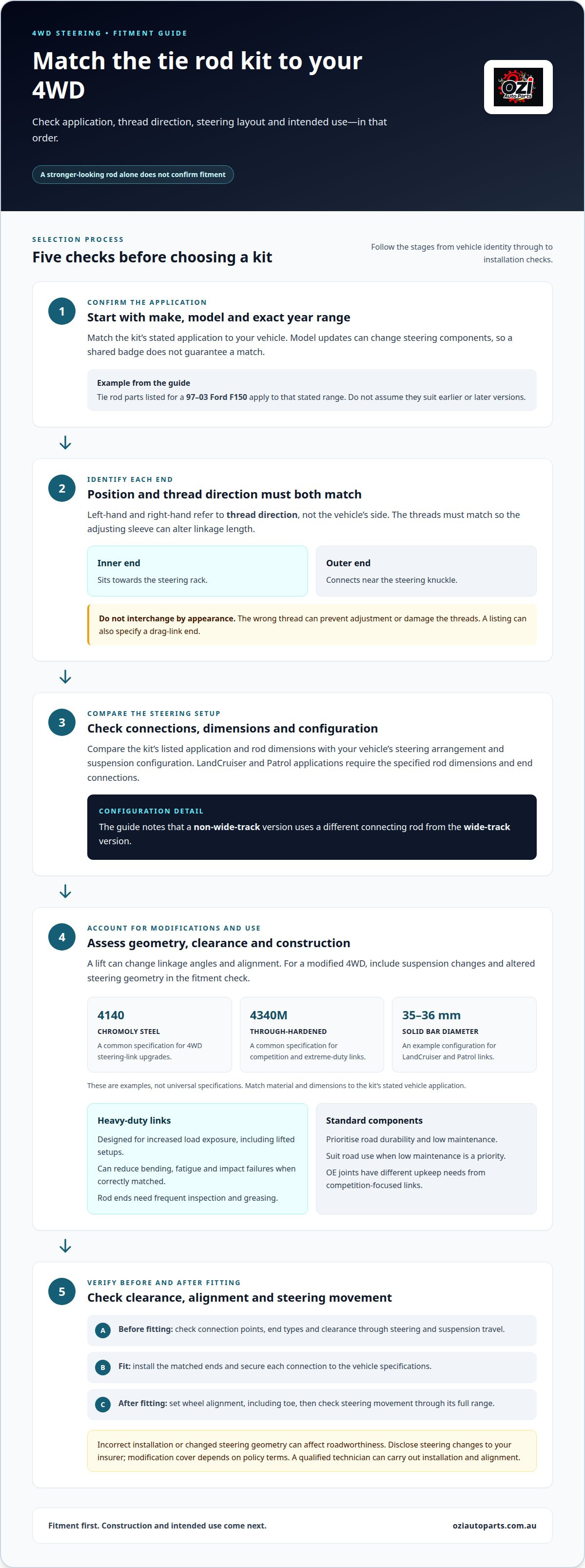
The poster states that the non-wide-track version uses a different connecting rod from the wide-track version. As the page advises, reassess steering damper length and mounting if steering fitment or geometry changes.
How do heavy duty tie rod kits compare with standard tie rods?
Standard tie rods prioritise road durability and low maintenance. Heavy-duty steering links target increased load exposure, including lifted 4WD setups. After a lift, upgraded links can help restore steering geometry. They can also reduce bending, fatigue and impact failures. The correct choice depends on vehicle application and driving conditions.
Material and construction distinguish many upgrades. Common specifications include:
- Grade 4140 chromoly steel for 4WD steering-link upgrades.
- Through-hardened 4340M for competition and extreme-duty links.
- Solid bar around 35-36 mm outside diameter for Toyota LandCruiser and Nissan Patrol links.
These examples describe common configurations, not universal specifications. Match material and dimensions to the kit’s vehicle application.
On a lifted Toyota LandCruiser, altered geometry can place different demands on steering links. A heavy-duty link can address increased exposure to bending and impact when it suits the vehicle’s steering layout. Standard components remain suitable for road use when low maintenance is a priority. More robust construction alone doesn’t confirm correct fitment or alignment.
Maintenance is another trade-off. Rod ends need frequent inspection and greasing. OE joints suit drivers prioritising road durability and less maintenance. For a Nissan Patrol used on demanding tracks, compare the kit’s application and joint requirements against intended use. A competition-focused 4340M link brings different upkeep needs from standard road-oriented joints. Build the decision around fitment, use and maintenance capacity.
Ozi Auto Parts
Ozi Auto Parts supplies 4WD upgrade parts and steering components for various vehicle makes. For a tie rod decision, its Steering and Suspension Parts and 4WD Upgrade Parts are the relevant categories. Compare your vehicle’s model, year and steering configuration with the kit’s stated application before selecting components.
Ozi Auto Parts also offers parts for other mechanical systems, including:
- Brake System Parts for brake component requirements.
- Driveshafts for driveline component requirements.
- 4WD Upgrade Parts for vehicle upgrades.
- Steering and Suspension Parts for steering and suspension components.
These categories help organise parts selection by vehicle system. For steering links, focus on the vehicle application, end configuration and rod specifications, and compare these details together. If the vehicle has modified suspension, include that configuration in your assessment because geometry affects steering-link fitment. A part’s general category alone doesn’t confirm compatibility.
Use the model and year, existing steering layout and modification details to narrow your selection. Consider related systems separately, then identify the component category relevant to each requirement. This makes it easier to distinguish steering parts from brake or driveline components while planning upgrades for your 4WD.
Contact Ozi Auto Parts about your parts requirements.
Frequently Asked Questions
What is a heavy duty tie rod kit for a 4WD?
It’s a steering-link replacement or upgrade kit designed for a specific four-wheel-drive application. Compared with buying an individual end, a kit groups the steering components needed for its stated fitment. Use the vehicle application and parts list to establish what the kit covers. The term “heavy duty” alone doesn’t define material, dimensions or included components.
Which heavy duty tie rod kits fit popular 4WD models in Australia?
Fitment depends on the exact vehicle model, year and steering configuration. LandCruiser, Patrol and Jeep Wrangler are model families, not proof that one kit suits every version. A kit listing should identify the applicable model and year range. On modified vehicles, suspension or steering changes also affect fitment. Don’t select a kit by make alone.
What components are included in a heavy duty 4WD tie rod kit?
Kit contents vary by vehicle application. A package may include connecting rods, tie rod ends and adjusting sleeves, but don’t assume every kit contains all three. Check the itemised parts list for the supplied components and quantities. This is important when replacing a single worn part or planning a complete steering-link change.
How much do heavy duty tie rod kits cost in Australia?
There isn’t one set price for every Australian 4WD application. The total depends on the vehicle fitment, kit contents and construction specified for that kit. Compare listings on the same basis: confirm the included components and application before weighing the price. A figure for a different vehicle or a single tie rod end isn’t a reliable guide to a complete kit.