
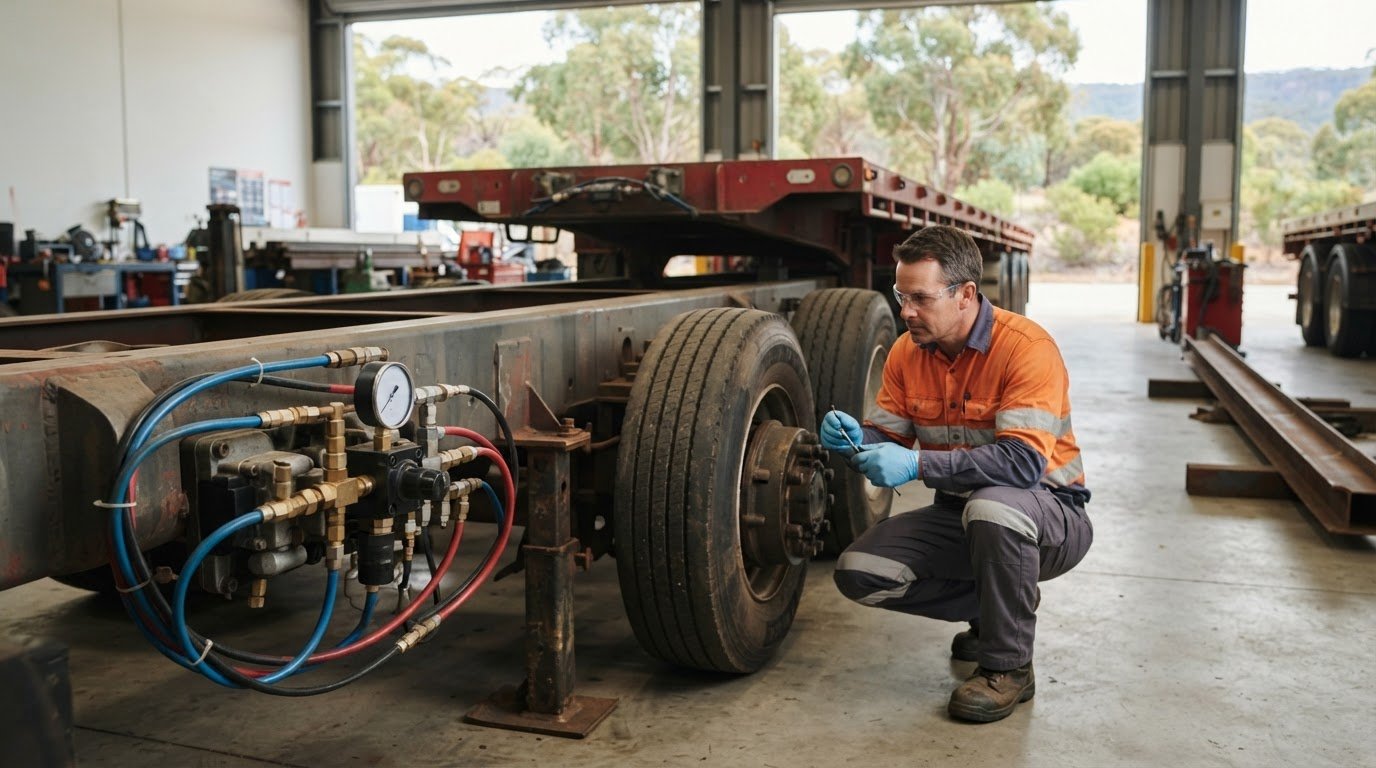
The ICS Trailers valve is cross-referenced to replacement part numbers 17600B, N14488R, S-19331 and SC17600B. Match the part number to the valve before selecting a replacement. After fitting a replacement trailer valve, complete a full park and emergency brake function test before returning the trailer to service.
A parking brake and a trailer emergency braking system serve different roles, but both depend on correctly operating components. Knowing how the mechanism works helps you recognise what to inspect and which details matter when matching a part.
This guide explains mechanical parking-brake operation, describes a safe function check and covers the valve cross-references listed. It also explains why a replacement trailer valve needs to be installed and tested by a qualified technician familiar with tractor-protection and emergency circuits.
Key Takeaways
- Identify whether you’re dealing with a mechanical parking brake, an electronic system or a trailer valve before choosing parts.
- Understand how the parking-brake cable transfers force to the wheel brakes and what that means for system operation.
- Learn the key checks used to assess park and emergency brake function after a replacement valve is fitted.
- Use the vehicle and component details to narrow your brake-parts selection and find the right next step.
Compatible replacement part numbers
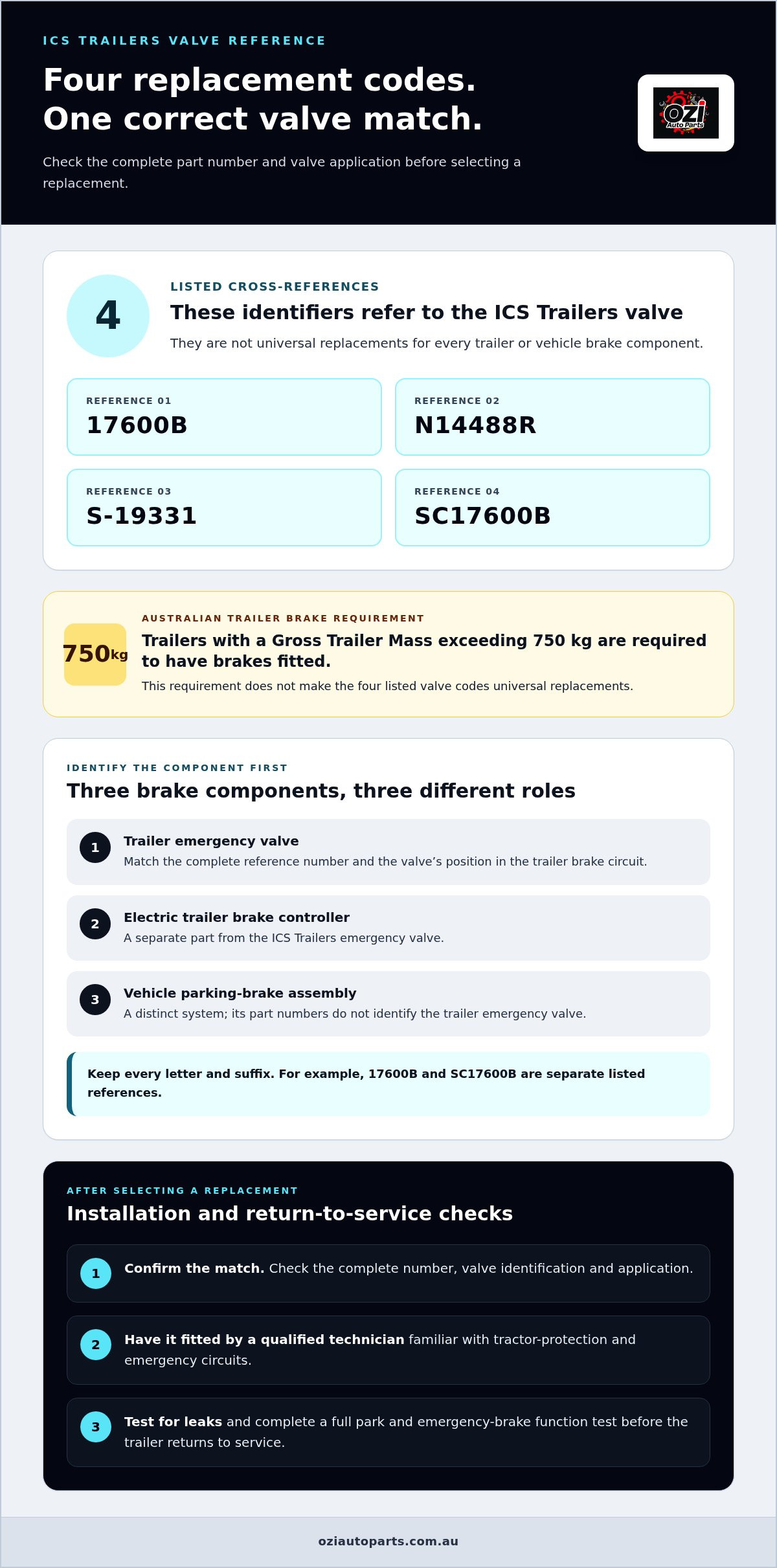
The ICS Trailers valve cross-reference lists four replacement part numbers: 17600B, N14488R, S-19331 and SC17600B. These identifiers refer to a trailer emergency valve, not every brake component on a vehicle. Match the number and valve application before selecting a replacement. A number from an electric brake controller or a vehicle’s parking-brake assembly identifies a different component.
- 17600B
- N14488R
- S-19331
- SC17600B
Use the complete number, including letters and any suffix. For example, 17600B and SC17600B are separate listed references, so don’t treat them as identical codes. Compare the number with the valve’s identification and its position in the trailer’s brake circuit. The trailer make alone doesn’t identify the correct valve.
In Australia, trailers with a Gross Trailer Mass exceeding 750 kg are required to have brakes fitted. That requirement doesn’t make these four codes universal replacements. They’re cross-references for the ICS Trailers valve. An electric trailer brake controller is a separate part, and a manual parking brake is another distinct system.
Have a qualified technician familiar with tractor-protection and emergency circuits install the replacement trailer emergency brake control valve and test for leaks. Before the trailer returns to service, the technician should complete a full park and emergency-brake function test. Correctly identifying and testing the valve helps establish that it operates in the intended circuit.
Mechanical parking brake operation
Mechanical parking brakes transfer driver input through cables to the wheel brakes. Their operation differs from electric trailer braking and electronic parking-brake systems.
Emergency brake control basics
A mechanical parking-brake mechanism uses a cable connected to two wheel brakes, usually at the rear. Applying the lever or pedal tensions the cable and engages the brakes. The cable, linkage and brake components must work together for the system to apply and release correctly. In an automatic-transmission vehicle, use the parking brake even when selecting Park, because the transmission parking pawl could fail.
Using the parking brake during brake failure
If the hydraulic brakes fail, apply the mechanical parking brake slowly to help reduce vehicle speed. Avoid a sudden pull or press; gradual engagement helps reduce the risk of locking the wheels. Emergency brake assist is a separate term from mechanical cable operation. On the Audi A8, the parking brake itself brakes the vehicle below 8 km/h; at higher speeds, ESP distributes brake pressure to all four wheel brakes.
Risks of emergency parking brake use
Using a parking brake while moving is not recommended unless the main brakes have a problem. Applying it abruptly can lock the rear wheels and cause a skid, so apply it gradually if the main brakes fail. A parking brake is not a substitute for an electric brake controller when towing a trailer. Identify the vehicle’s system type before diagnosing a fault or choosing replacement components.
On the BMW 7 Series, the parking brake carries out an automatic braking routine around once a month or every 1000 km. This routine is separate from using the parking brake to respond to hydraulic brake failure. In that situation, the brake can help slow the vehicle, but engage it slowly to avoid locking the wheels; abrupt application risks a skid.
What is emergency brake control in a car?
In a car, emergency brake control usually means the control used to apply the parking brake. It may operate a mechanical parking brake or an electric park brake. The term does not refer to a trailer brake controller, which manages the trailer’s braking system, or hill-hold, which helps prevent rollback when starting on an uphill slope.
With an electric park brake, a motor may pull the parking-brake cable when the driver presses or pulls a button. Some electronic systems engage automatically when the vehicle stops and release when the accelerator is pressed. Operation depends on the vehicle’s fitted system, so identify the control before interpreting warning lights or checking its function.
Electronic parking brakes entered the mainstream market in 2001, first appearing in the BMW 7 Series (E65). The more complex Motor on Caliper system appeared on the 2003 Audi A8. These examples show that electronic designs differ: a cable-pulling motor and a motor mounted at the calliper don’t apply braking force through identical arrangements.
Hill-hold is a separate function. It’s designed to prevent a vehicle rolling backwards when starting on an uphill gradient; it isn’t the parking-brake control. On the Audi A8, the parking brake itself brakes the vehicle only below 8 km/h. At higher speeds, the ESP system distributes brake pressure to all four wheel brakes.
For replacement components associated with the vehicle’s braking system, browse brake parts and match the component to the vehicle application.
Ozi Auto Parts: Brake System Parts
Ozi Auto Parts supplies Brake System Parts for drivers selecting replacement components for a vehicle’s braking system. Use the vehicle’s make, model and existing part details to narrow the selection and avoid confusing a car parking-brake component with a trailer emergency valve or electric brake controller.
For related mechanical upgrades, the range also includes Brake Boosters, Driveshafts, 4WD Upgrade Parts, and Steering and Suspension Parts. These categories address different vehicle systems, so select according to the part required rather than treating them as interchangeable. For example, a brake booster supports the vehicle’s braking system; it isn’t a parking-brake control.
Review the available parts at oziautoparts.com.au, or contact Ozi Auto Parts for help selecting a suitable component.
Make your next parts decision count
Before choosing a replacement, identify which system the component belongs to. A vehicle parking-brake mechanism, a trailer emergency circuit and hydraulic service brakes perform different functions. Matching the part to the correct system is the practical next step after diagnosis, particularly when similar descriptions appear across applications. Note the vehicle details and markings on the existing component to help guide your selection.
Ozi Auto Parts supplies Brake System Parts, Driveshafts and 4WD Upgrade Parts. Use the vehicle’s make, model and component details to narrow the relevant category. A correctly selected emergency brake control component supports a more informed parts decision, while installation and operational testing remain separate tasks.
For help with your parts requirements, contact Ozi Auto Parts. Bring the component information you have and take the next step with a clearer selection.
Frequently Asked Questions
How do I test or maintain my car’s emergency braking system safely?
Check the parking brake with the car stationary on level ground and away from traffic. Secure the vehicle, apply the brake, then release it and check that the dashboard indicator responds as expected. Do not test braking force by applying the parking brake while driving. Follow the vehicle handbook’s maintenance procedure, and arrange an inspection if the brake does not hold or the warning indicator behaves abnormally.
What are common emergency brake control warning lights and faults?
Warning lights and faults vary with the fitted system. If the parking brake does not hold or its warning indicator behaves abnormally, arrange an inspection.